 Back to News
GenSight Biologics reports new analysis demonstrating statistically significant and clinically meaningful difference between visual outcomes in LUMEVOQ®-treated patients and natural history of Leber Hereditary Optic Neuropathy (LHON)
Paris, France, Monday, September 21, 2020, 7.30 am CEST – GenSight Biologics (Euronext: SIGHT, ISIN: FR0013183985, PEA-PME eligible), a biopharma company focused on developing and commercializing innovative gene therapies for retinal neurodegenerative diseases and central nervous system disorders, today reported that statistical analysis of pooled data from LUMEVOQ® trials and natural history studies found a statistically significant and clinically meaningful difference between the visual outcomes in LUMEVOQ®-treated patients and untreated patients.
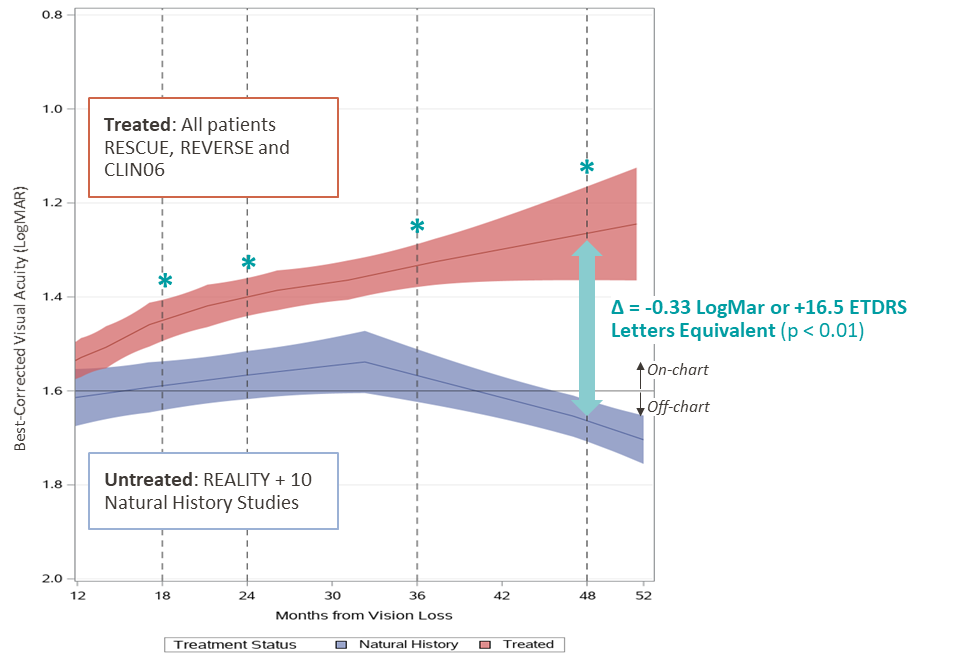
Treated eyes showed progressive and sustained improvement from Month 12 to Month 52, in contrast to the absence of recovery over the same period for untreated eyes. At Month 18, the difference became statistically significant (p=0.01). By Month 48, the difference between the mean visual acuity in treated patients and that in untreated patients was both statistically significant (p<0.01) and clinically meaningful (-0.33 LogMAR, or +16.5 ETDRS letters equivalent, in favor of treated eyes).
Figure 1. Evolution of Visual Acuity in LUMEVOQ®-treated Patients (N=76) versus Untreated Patients (N=208)
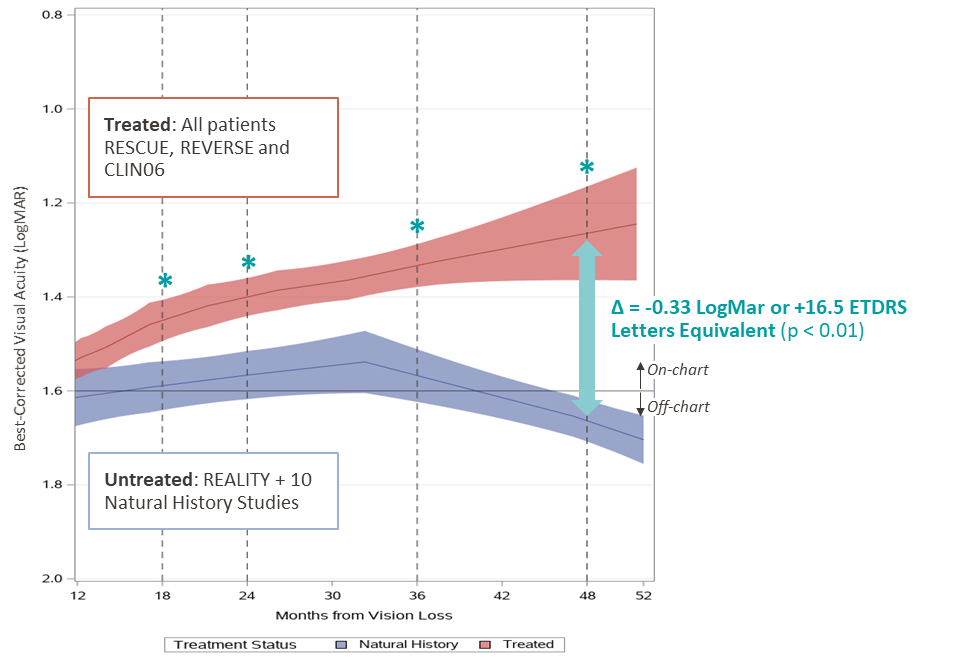 Note: All patients had a confirmed G11778A mutation in the ND4 mitochondrial gene and were at least 15 years old. The diagram shows the Locally Estimated Scatterplot Smoothing (LOESS) curves for visual acuity in LUMEVOQ®-treated patients and untreated patients. The shaded areas represent the 95% confidence interval for the mean BCVA. “Treated” eyes refer to all eyes (LUMEVOQ® and sham) from the RESCUE, REVERSE and CLIN06 trials (N=76 patients / 152 eyes). Untreated eyes refer to patient-level data from the REALITY study and a matched data set from two prospective and eight retrospective natural history studies1 (N=208 patients / 408 eyes). LOESS curves were estimated using a non-parametric, local regression model that treated each eye as independent of the other. LOESS curves are shown from Month 12 to depict post-treatment progression among treated patients (93% of LUMEVOQ® patients had already been treated within 12 months from onset). *Statistically significant difference between mean visual acuity of treated and untreated eyes at M18, M24, M36 and M48, as illustrated by the non-overlapping confidence intervals.
The analysis compared data from the completed Phase III trials RESCUE and REVERSE studies and interim results from the long-term follow-up CLIN06 study to a matched sample created from the REALITY registry study and 10 other natural history studies1. The natural history studies were identified from an extensive review of the scientific literature and selected based on specific inclusion criteria for their patient-level data. In all, the visual outcomes in 76 treated patients could be compared to the visual outcomes of 208 untreated patients.
“The extra granularity of this analysis down to individual patient data confirms that the natural history of visual outcomes in ND4-LHON patients is poor and provides the best comparison we have for assessing the therapeutic efficacy of gene therapy,” commented Dr. Nancy J. Newman, MD, LeoDelle Jolley Professor of Ophthalmology and Neurology at the Emory University School of Medicine in Atlanta, GA, USA, and a global authority on LHON who recently completed a meta-analysis of the natural history of ND4-LHON.2
Separate analyses of patients enrolled in RESCUE and REVERSE demonstrated similarly favorable results compared to untreated patients. Full findings from the indirect comparison were included in the European Marketing Authorisation Application (MAA) for LUMEVOQ® and are being prepared for publication in a peer-reviewed journal.
“This indirect comparison represents a significant contribution to our understanding of LUMEVOQ®’s therapeutic effect,” said Dr. José-Alain Sahel, MD, Director of the Institut de la Vision (Sorbonne-Université/Inserm/CNRS), Paris, France; Chairman of the Department of Ophthalmology at Centre Hospitalier National d’Ophtalmologie des XV-XX, Paris, France; Professor and Chairman of the Department of Ophthalmology at University of Pittsburgh School of Medicine and UPMC (University of Pittsburgh Medical Center), USA; and Co-Founder of GenSight Biologics. “The use of a large external control group, including analyses of patient-level data, provides more evidence for a significant treatment-related visual improvement.”
“The findings are a gratifying outcome of our push to overcome a key challenge for assessing LUMEVOQ®’s efficacy, namely the inability of sham eyes to act as a control group,” commented Bernard Gilly, Co-founder and Chief Executive Officer of GenSight. “We are excited to take this evidence – that LUMEVOQ® modifies the disease outcome – forward into our conversations with national and regional authorities.”
The LUMEVOQ® MAA was filed in September, and the decision is expected in H2 2021. The Company is also working towards submitting LUMEVOQ®’s Biologics License Application (BLA) to the FDA in H2 2021.
GenSight will host a conference call today, September 21, 2020, at 10am CEST in French, and at 2.00pm CEST (8.00am EST) in English, to discuss these results.
Webcast & Conference call in French (10am CEST)
Dial-in numbers:
Note: All patients had a confirmed G11778A mutation in the ND4 mitochondrial gene and were at least 15 years old. The diagram shows the Locally Estimated Scatterplot Smoothing (LOESS) curves for visual acuity in LUMEVOQ®-treated patients and untreated patients. The shaded areas represent the 95% confidence interval for the mean BCVA. “Treated” eyes refer to all eyes (LUMEVOQ® and sham) from the RESCUE, REVERSE and CLIN06 trials (N=76 patients / 152 eyes). Untreated eyes refer to patient-level data from the REALITY study and a matched data set from two prospective and eight retrospective natural history studies1 (N=208 patients / 408 eyes). LOESS curves were estimated using a non-parametric, local regression model that treated each eye as independent of the other. LOESS curves are shown from Month 12 to depict post-treatment progression among treated patients (93% of LUMEVOQ® patients had already been treated within 12 months from onset). *Statistically significant difference between mean visual acuity of treated and untreated eyes at M18, M24, M36 and M48, as illustrated by the non-overlapping confidence intervals.
The analysis compared data from the completed Phase III trials RESCUE and REVERSE studies and interim results from the long-term follow-up CLIN06 study to a matched sample created from the REALITY registry study and 10 other natural history studies1. The natural history studies were identified from an extensive review of the scientific literature and selected based on specific inclusion criteria for their patient-level data. In all, the visual outcomes in 76 treated patients could be compared to the visual outcomes of 208 untreated patients.
“The extra granularity of this analysis down to individual patient data confirms that the natural history of visual outcomes in ND4-LHON patients is poor and provides the best comparison we have for assessing the therapeutic efficacy of gene therapy,” commented Dr. Nancy J. Newman, MD, LeoDelle Jolley Professor of Ophthalmology and Neurology at the Emory University School of Medicine in Atlanta, GA, USA, and a global authority on LHON who recently completed a meta-analysis of the natural history of ND4-LHON.2
Separate analyses of patients enrolled in RESCUE and REVERSE demonstrated similarly favorable results compared to untreated patients. Full findings from the indirect comparison were included in the European Marketing Authorisation Application (MAA) for LUMEVOQ® and are being prepared for publication in a peer-reviewed journal.
“This indirect comparison represents a significant contribution to our understanding of LUMEVOQ®’s therapeutic effect,” said Dr. José-Alain Sahel, MD, Director of the Institut de la Vision (Sorbonne-Université/Inserm/CNRS), Paris, France; Chairman of the Department of Ophthalmology at Centre Hospitalier National d’Ophtalmologie des XV-XX, Paris, France; Professor and Chairman of the Department of Ophthalmology at University of Pittsburgh School of Medicine and UPMC (University of Pittsburgh Medical Center), USA; and Co-Founder of GenSight Biologics. “The use of a large external control group, including analyses of patient-level data, provides more evidence for a significant treatment-related visual improvement.”
“The findings are a gratifying outcome of our push to overcome a key challenge for assessing LUMEVOQ®’s efficacy, namely the inability of sham eyes to act as a control group,” commented Bernard Gilly, Co-founder and Chief Executive Officer of GenSight. “We are excited to take this evidence – that LUMEVOQ® modifies the disease outcome – forward into our conversations with national and regional authorities.”
The LUMEVOQ® MAA was filed in September, and the decision is expected in H2 2021. The Company is also working towards submitting LUMEVOQ®’s Biologics License Application (BLA) to the FDA in H2 2021.
GenSight will host a conference call today, September 21, 2020, at 10am CEST in French, and at 2.00pm CEST (8.00am EST) in English, to discuss these results.
Webcast & Conference call in French (10am CEST)
Dial-in numbers:
- United States: +1 212 999 6659
- France: +33 (0)1 7037 7166
- United Kingdom: +44 (0)20 3003 2666
- United States: +1 212 999 6659
- France: +33 (0) 1 7037 7166
- United Kingdom: +44 (0) 20 3003 2666
