GenSight Biologics Withdraws its EMA Application for LUMEVOQ®
Paris, France, April 20, 2023, at 4:00 pm CEST – GenSight Biologics (Euronext: SIGHT, ISIN: FR0013183985, PEA-PME eligible), a biopharma company focused on developing and commercializing innovative gene therapies for retinal neurodegenerative diseases and central nervous system disorders, today announces that the Committee for Advanced Therapies (CAT)[1] of the Committee Medicinal Products for Human Use (CHMP) of the European Medicines Agency (EMA) assessed the data presented during the oral explanation[2] on LUMEVOQ® European regulatory dossier.
As provided by the review procedure and following responses to the D180 questions, an oral explanation was held on April 19. GenSight invited the world renowned LHON[3] experts, Patrick Yu-Wai-Man, MD, PhD (Cambridge University, UK) and José-Alain Sahel, MD (University of Pittsburgh School of Medicine, USA) to share their clinical practice and perspective on LUMEVOQ® data.
Following interactions with the CAT indicating that the data provided thus far would not be sufficient to support a positive opinion of the marketing authorization of LUMEVOQ® by EMA, GenSight decided to withdraw its application ahead of a final opinion by the CAT. This decision enables the Company to discuss the best possible path forward for LUMEVOQ® with the EMA in the coming weeks, aiming at submitting a new application addressing remaining objections as soon as possible, in Europe and other countries. The company is exploring options including generating new clinical data, which may induce material delays and additional costs.
“GenSight teams have gathered a huge dataset of 252 ND4-LHON patients treated with LUMEVOQ showing that 70% of LUMEVOQ-treated patients present a visual recovery, in contrast to the poor and limited recovery observed in the natural history of the disease,” said José-Alain Sahel, Co-founder of GenSight Biologics and of the Institut de la Vision, Paris, France, “In light of the study results, confirmed by real-life data, LUMEVOQ is the current best therapeutic option for ND4-LHON patients given the 3-fold difference in vision function in treated patients. It is disappointing that the contralateral effect of the therapy limited the perceived strength of these data, published in top-tier peer-reviewed journals by leaders in the field.”
“We disagree with the current CAT assessment and remain highly confident in the clinical benefit of LUMEVOQ for LHON patients, which is supported by extensive evidence from multiple clinical trials and real-world data,” commented Bernard Gilly, Chief Executive Officer and Co-Founder of GenSight Biologics. “The decision to withdraw our application allows us to continue to work with EMA to agree as soon as possible on a regulatory path forward. I want to thank the patient communities for their support and reaffirm our determination to bring this innovative therapy to ND4-LHON patients in need of an efficacious treatment. I also want to thank the scientific community and our teams for their long-lasting commitment.”
GenSight confirms that the manufacturing validation campaign is on track with its partner in the United-States, as planned, with a product released for human use by the end of the year.
GenSight’s Marketing Authorization Application (MAA) submission of LUMEVOQ® to the EMA was based on the benefit-risk balance established by results from 252 patients treated through clinical trials or compassionate use. This unprecedented data set for ND4-LHON establishes that LUMEVOQâ efficacy compares positively to both natural history and idebenone.
GenSight management team will host a live webcast at 4:30 pm CEST (10:30 am EST) today to further comment on this decision. The webcast will be held in English, and a simultaneous French translation will also be available.
Live webcast in English, with a simultaneous French translation also available: https://bit.ly/3LcxrMD
The webcast will be available in replay using the same link above.
The Company will report its cash position as of March 31, 2023, in a separate press release later today.
[1] The Committee for Advanced Therapies (CAT) is the European Medicines Agency’s (EMA) committee responsible for assessing the quality, safety and efficacy of advanced therapy medicinal products (ATMPs) and following scientific developments in the field.
[2] After the second clock-stop, an oral explanation in which the applicant directly addresses the committee can be requested either by the applicant or by the CHMP – https://www.ema.europa.eu/en/human-regulatory/marketing-authorisation/evaluation-medicines-step-step#clock-stop-2-section
[3] Leber hereditary optic neuropathy (LHON) and ND4 is the most frequent mutation with worst prognosis for LHON patients
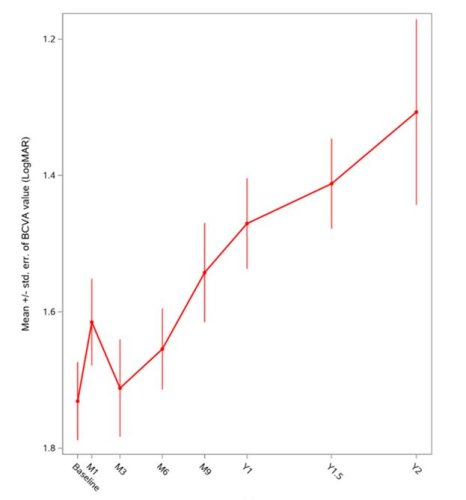
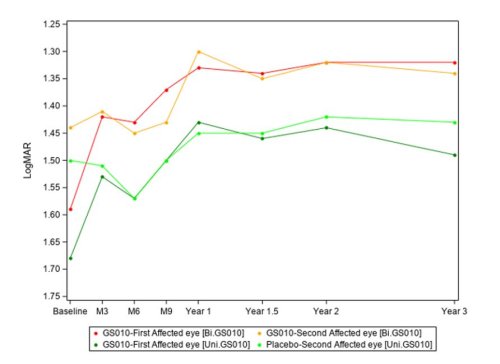
 Table 1: Change in Best-Corrected Visual Acuity (BCVA) versus Nadir 3 Years after Injection
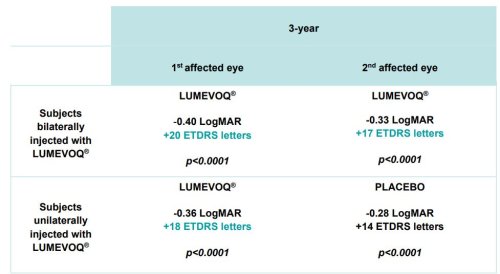 Data cut-off: Nov 28, 2022. Subjects bilaterally treated : 1st affected eyes: n=48; 2nd affected eyes: n=48; subjects unilaterally treated: 1st affected eyes: n=50; 2nd affected eyes: n=50.
Comparison against nadir (i.e., the worst BCVA recorded from baseline to Year 3) starkly demonstrates the efficacy of lenadogene nolparvovec, even for the placebo eyes that improved via a contralateral treatment effect (also documented in sham-treated eyes in the REVERSE2 and RESCUE3 trials).
Responder analyses point to the benefits of treatment for patients that would otherwise have experienced significant vision loss with a very low likelihood of spontaneous recovery (partial recovery in 11% of patients described in the literature).1 Three years after a bilateral injection, 73% of patients had experienced a clinically meaningful improvement of at least -0.3 LogMAR (+15 ETDRS letters) relative to their observed nadir, and, among patients who were not able to read any letters on a screen at baseline (off-chart values for both eyes), 62% are now able to read letters.
Favorable safety profile
The favorable safety profile of lenadogene nolparvovec continued to be confirmed, with the safety profile of the drug being demonstrated as comparable in bilaterally and unilaterally treated subjects. There was no study discontinuation related to systemic or ocular adverse events, and there were no serious ocular adverse events. The main ocular adverse event was intraocular inflammation, which was mostly mild and responsive to conventional treatment.
REFLECT patients will be followed up to 5 years post-injection to monitor the efficacy and safety of lenadogene nolparvovec over time.
“We are very pleased to see that this 3 years’ follow-up results from the REFLECT trial confirm the durable and meaningful efficacy of lenadogene nolparvovec, particularly for bilaterally treated patients,” said Bernard Gilly, CEO and Co-Founder of GenSight Biologics. “The body of clinical evidence is making a compelling case that this gene therapy represents real hope for patients affected by this devastating blinding disease. These latest data will provide further significant support for the ongoing review of our dossier by the EMA.”
References:
